From 4 November 2026, Paris offers more than 1,400 works from the residence of His Highness Sheikh Hamad bin Abdullah Al Thani. Here are the three we'd walk into the room for.
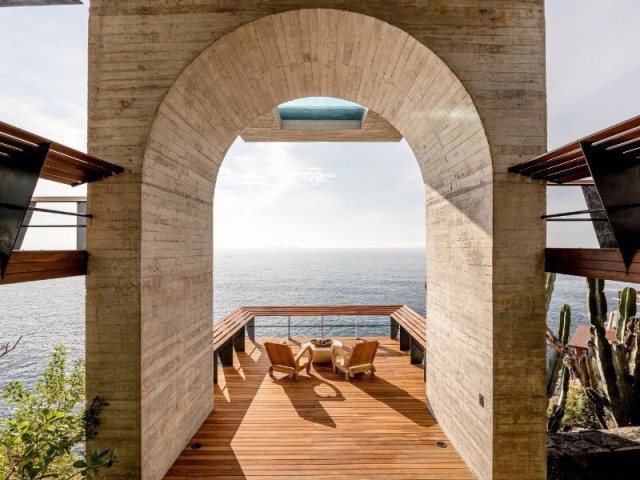
Some sales offer objects. This one offers a whole interior. In the heart of the 7th arrondissement, overlooking the Eiffel Tower, His Highness Sheikh Hamad bin Abdullah Al Thani spent years assembling one of the most remarkable private residences in Paris. Working closely with the legendary decorator Alberto Pinto, he shaped it room by room and object by object, until architecture, decoration and collecting became a single world.
Now, Paris is bringing that world to auction. Across five sales from 2 to 9 November 2026, more than 1,400 works will be offered, spanning old masters, decorative arts, silver, antiques, furniture, paintings and design. Before the sales, the interiors will be recreated in immersive exhibitions at 83 and 76 Rue du Faubourg Saint-Honoré, open from 31 October to 4 November.
From the Evening Sale on 4 November, we chose three pieces that show the range: a pair of sofas from a Genoese palace, a Roman marble that stood for two centuries in an English great hall, and a portrait of a queen.
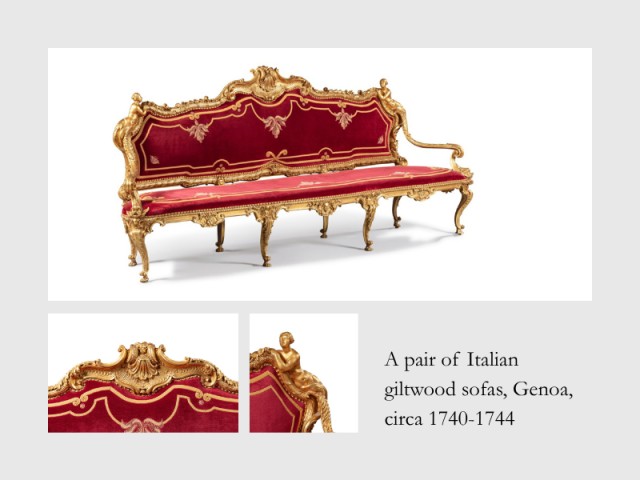
1. A pair of Italian giltwood sofas, Genoa, circa 1740–1744
For anyone who loves Italian interiors, this is the lot to watch, and it carries the top estimate of our three picks at €400,000–600,000. The pair of giltwood sofas was made for the Galleria Dorata of Palazzo Carrega-Cataldi on Genoa's Via Garibaldi, one of the most celebrated rooms of the Genoese Rococo.
Their story then crosses the Atlantic. In the late 19th century the architect Stanford White acquired them and shipped them to New York, where they furnished the ballroom of William Collins Whitney's mansion at 871 Fifth Avenue, before passing to Harry Payne Whitney and Gertrude Vanderbilt Whitney. Later they returned to Italy, to Count Volpi di Misurata at Palazzo Volpi in Rome.
The carving is extraordinary: a scallop-shell cresting, mermaids on each side rail, dolphin supports, lion masks and swags of flowers, all on cabriole legs ending in paw feet. Each sofa is 282 cm wide, built to hold a grand room.
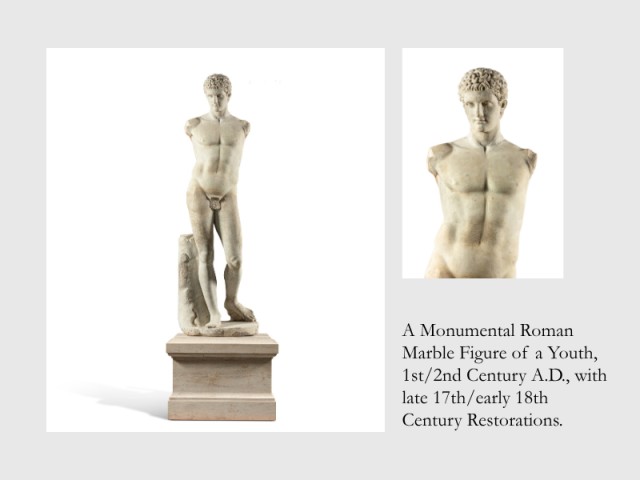
2. A Monumental Roman Marble Figure of a Youth, 1st/2nd Century A.D.
Standing more than two metres tall, this Roman marble youth is estimated at €250,000–400,000. It entered the collection of Thomas Herbert, 8th Earl of Pembroke, and from the early 1720s it stood in a niche in the Great Hall at Wilton House, one of the grandest rooms in England, facing a statue of Mercury.
It stayed with the Earls of Pembroke for eight generations. After it was sold in 1961, it spent decades in an unexpected setting: the middle of a garden pond at The Old Rectory in Burghfield, Berkshire. The name "Antinous" on its base was probably added by the 8th Earl himself, a collector who could not bear to leave a statue anonymous.
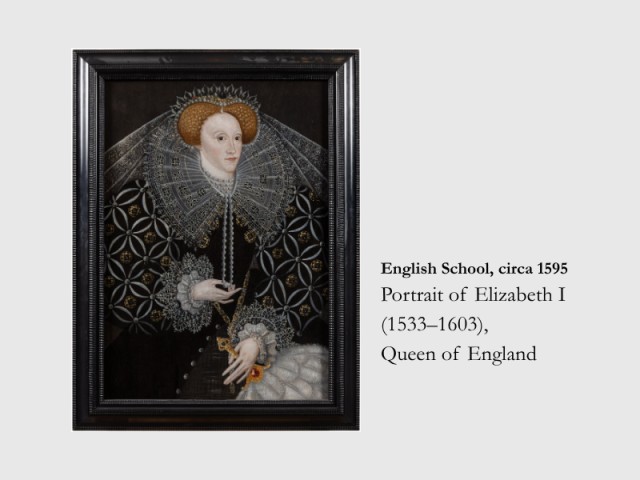
3. English School, circa 1595: Portrait of Elizabeth I
At €150,000–200,000, this portrait of Elizabeth I shows the Queen near the end of her reign, at around 62, in her personal colours of black and white. She holds a string of pearls, a symbol of chastity, and a feather fan, the kind of luxury gift courtiers gave her at New Year.
It belongs to the "Weavers' Company type" identified by Sir Roy Strong, based on the famous Darnley face pattern in the National Portrait Gallery. It was likely painted for the gallery of Heslington Hall in Yorkshire, reportedly filled with portraits in anticipation of a royal visit, and it stayed in that house for centuries.