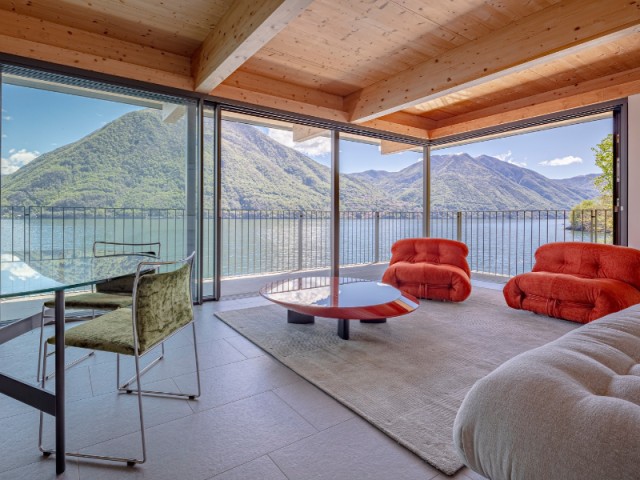
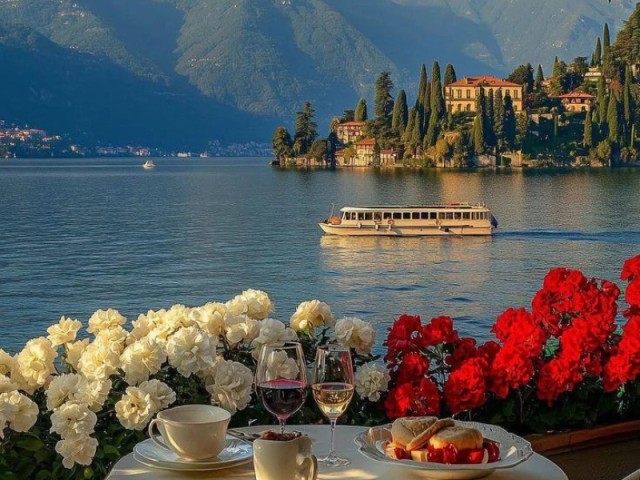
The summer fills the lake. The winter shows who it is for.
In November the west shore begins to close. Shutters come down on the summer villas one by one, the boats keep a shorter timetable, and the light arrives late and leaves early, low across the water. Each year someone asks me whether this is the wrong moment to present a property of distinction. The question is reasonable. It assumes that a place is best seen when it is most admired. I am not sure that is true. A property seen in August is seen at its most generous. A property seen in January is seen as it is.
The conventional reading of the calendar is well known. In most markets that publish such data, spring is the busiest season: more properties come forward, more viewings are booked, more sales are agreed. Winter is quieter on every count. In the American Economic Review in 2014, the economists L. Rachel Ngai and Silvana Tenreyro gave the pattern a name: in the United Kingdom and the United States, prices and sales rise above trend in spring and summer, the hot season, and fall below it in autumn and winter, the cold one.
Italy does not follow the rule. According to the Osservatorio del Mercato Immobiliare of the Agenzia delle Entrate, just over 218,000 residential properties changed hands in the last quarter of 2025, from October to December, against fewer than 175,000 in the summer quarter before it. In the North West, where the lake lies, the figures were 76,354 and 59,404. The Italian figures count deeds, signed weeks or months after a price is agreed, so they record when sales close, not when people decide. Even so, the Italian winter is not an empty season.
But the figures count volume. They describe cities and national markets, where thousands of properties change hands and a season shows in the totals. They record how many, not who, and not why. It is the right measure for a capital. It is not the measure of a lake.
On the first basin, historic villas do not come to market because the calendar turns. They come because a family has decided something: a succession has been settled, a generation has moved on, the next hands have been chosen or have not yet been found. A season cannot hurry that, and it cannot delay it either.
What winter does is change what can be seen. It begins with the light. In winter it reaches only the rooms that were placed to receive it, and a visitor learns in an hour what a summer viewing would not tell them: which rooms hold warmth, which garden lies in shade until noon, how a lower floor keeps the damp, how the road behaves in rain. Then comes the stillness. With the terraces empty and the boats few, a place is heard as well as seen, and silence is one of the things its next custodian is choosing.
Then comes the visitor. The person who travels to the lake in January is rarely passing through. They have made the journey for one reason, they have fewer distractions, and they ask the questions that matter: what has been done to the roof, the walls, the water; what the property will ask of the next family in the months it is not lived in. These are slower conversations, and better ones.
Stability pulls the other way. A property presented in summer has the season on its side, and some will say it is a pity to give that up. Perhaps. But a place that is wanted in February has been chosen without the help of the weather, and a choice made that way tends to last.
And some return. More than once I have walked a villa in August with someone who came back in winter to see it again, quietly, to know whether it was the place or the summer they had fallen for. I have come to think the second visit is the one that decides. Those who travel to the lake in winter have, for the most part, already chosen the lake; what remains is the house. A property that is ready meets them first, and by April, many of them will have chosen.
What I take from this is that winter is not a worse time to be seen. It is a more honest one. The season does not decide whether a property is ready to pass to the next hands; the property does. A place whose deferred work has been addressed, whose rooms are warm and whose story is in order will be read well in any month. A place that depends on the summer to carry it will be read well only in summer, and the next family will discover the rest in their first January.
To those considering whether to present a property this winter: there is no need to wait for spring, and no reason to hurry before it. Open the shutters on a grey morning and walk the rooms as a stranger would. If the place still speaks, the season will not silence it.
For a private conversation, write to me.